If you have been comparing Virginia Beach neighborhoods on a listing portal, Alanton looks like a clean data point. A median sale price hovering right around a million dollars. Roughly nineteen days on market. A short list of active homes. Simple.
The number is close to useless. Alanton does not have one market. It has two, and the gap between them is the entire story.
One neighborhood, two price tiers
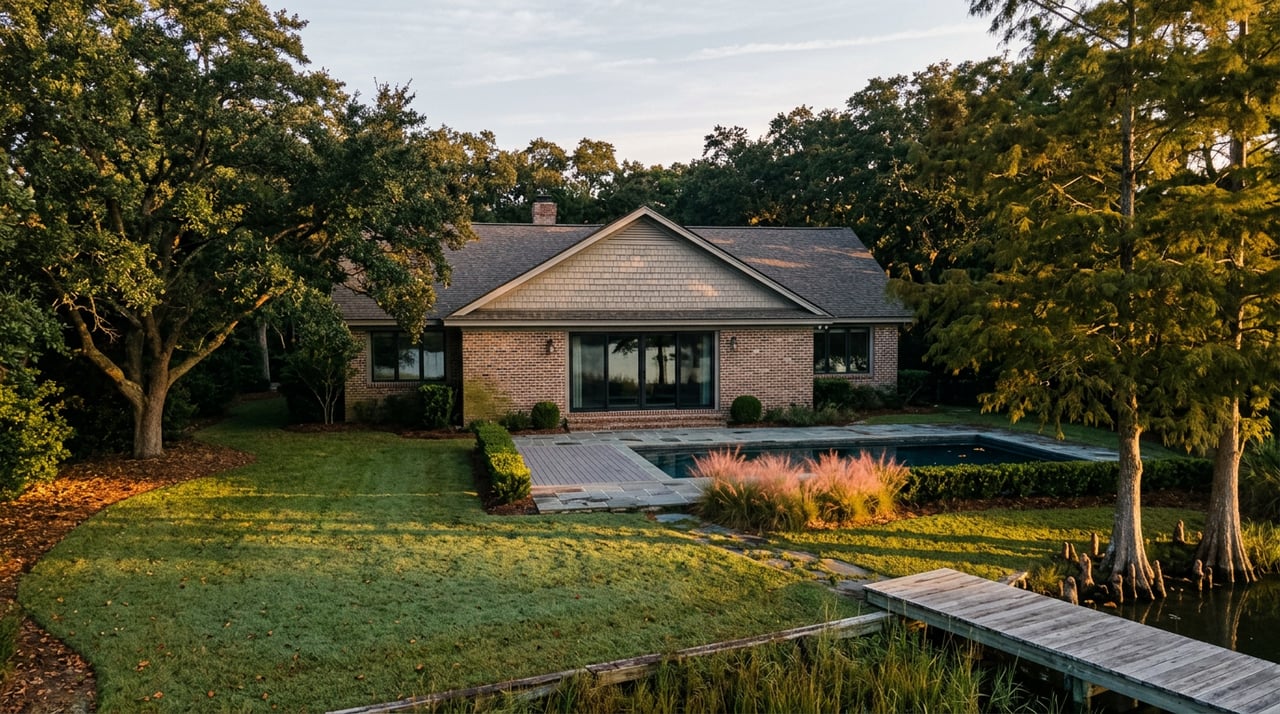
Alanton is a peninsula bounded by Broad Bay to the north and Linkhorn Bay to the south, and the water is not decoration. It is the pricing mechanism. Homes on the perimeter with direct bay frontage, private piers, and dock infrastructure trade in a range of roughly $1.7M to well above $5M. Interior homes, walking distance to the same water but without frontage, trade in the $900K to $1.4M band. Both are Alanton. They are not the same product.
Three closed sales tell the story cleanly:
| Address | Closed | Price | $/SF | DOM | Type |
|---|---|---|---|---|---|
| 1256 Alanton Dr | Feb 2026 | $1,200,000 | $312 | 14 | Interior |
| 1440 Alanton Dr | Dec 2025 | $1,790,000 | $404 | 18 | Interior/premium |
| 1845 N Alanton Dr | Sep 2025 | $5,200,000 | $686 | 33 | Waterfront |
The $/SF column is where a buyer should stop. A well-renovated interior home clears in the low $300s per foot. A comparable-footage waterfront estate clears at more than double that, and it takes longer to sell because the pool of buyers narrows sharply above $3M. When a portal blends those into a single median around $1,003,500 for the trailing twelve months at Alanton, per Homes.com data as of mid-2026, the number describes no actual house you can buy.
What the regional data quietly leaves out
The June 2026 REIN market summary shows Hampton Roads at a record $395,000 median sale price, up 5.33% year over year, with 19 days on market regionally. Virginia Beach detached homes are closing at 100.1% of original list, with a median 9 days on market and 1.5 months of supply, per REIN/Domus figures pulled July 1, 2026.
Read the footnote. Those city-level detached figures exclude waterfront and new construction. That is standard methodology for a reason. Waterfront distorts every measure it touches. The problem is that the exclusion works cleanly for a Kempsville three-bedroom and not at all for Alanton, where the waterfront tier is not a rounding error. It is half the reason the neighborhood exists.
Applied to Alanton, the citywide 9-day, over-list dynamic describes the interior tier reasonably well. The waterfront tier behaves differently. Fewer buyers. Longer marketing periods. More price discovery. Anyone benchmarking Alanton to city aggregates is comparing two different asset classes.
The dock is the asset
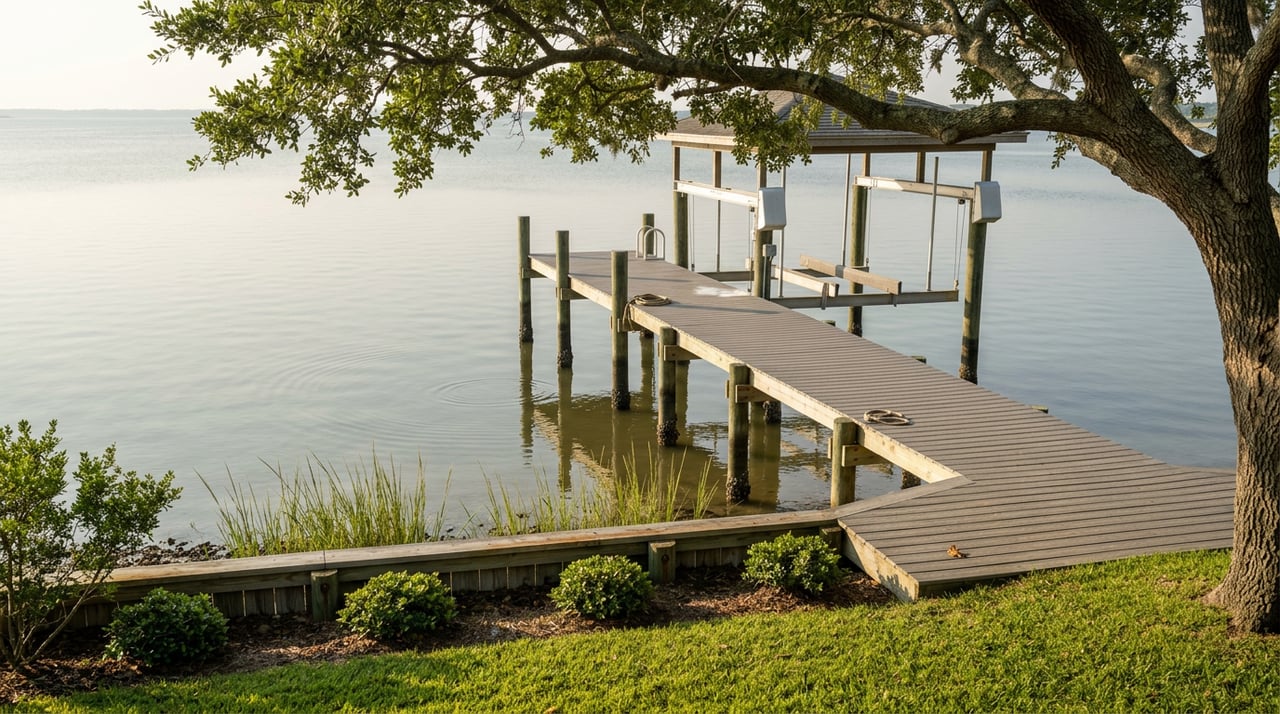
For a serious buyer on the water side of Alanton, the house is often the second most important structure on the lot. The dock is the first. Four variables determine what a waterfront listing is actually worth, and none of them show up on a portal:
- Mean low water depth at the pier. Both Linkhorn Bay and Broad Bay have shallower sections at low tide. A listing currently on the market advertises "3 ft of water at low tide" as a feature, which tells you exactly how granular this gets. A vessel with meaningful draft cannot use a pier that shows two feet at MLW, regardless of how the photos look at high tide.
- Dock structure and age. Hampton Roads docks take a beating from marine growth, storms, and salt. A dock that reads as functional above water can carry six figures of substructure repair. Budget for a dock inspection separately from the standard home inspection.
- Bulkhead condition. Bulkheads fail slowly and then all at once. Replacement runs well into the tens of thousands, and permitting a shoreline structure is a distinct process from any interior renovation.
- Flood zone designation. Most Alanton waterfront properties carry AE or VE FEMA flood zone classifications, which drives insurance cost and, in a VE zone, construction standards for any future rebuild.
The result is that two Linkhorn Bay homes with similar square footage and similar list prices can be very different assets. One has six feet at MLW, a rebuilt bulkhead, and a five-year-old pier with a boat lift. The other has three feet at MLW, a bulkhead nearing end of life, and a pier that needs decking. The gap between them at closing is often larger than the gap between an interior home and a waterfront home.
The community boat ramp changes the math
Here is the piece that almost never makes it into a portal listing description. Alanton has its own community boat ramp with access to both bays, available to all resident homeowners, waterfront or not.
That single fact reprices the interior tier. A buyer who wants a boat, morning paddleboards on Linkhorn Cove, or fishing for spotted seatrout and puppy drum does not have to pay the waterfront premium to get water access. The lifestyle case for a $1.1M interior home in Alanton is not "close to the water." It is "on the water, with a garage instead of a private pier."
The median is commodity data. The community ramp is local knowledge. Interior Alanton is arguably the best price-to-lifestyle trade in the Great Neck corridor, and the portals cannot see it.
Non-waterfront buyers still get the acre lots, the cedar-lined Woodhouse Road entry off Mill Dam, the Alanton-Baycliff Recreation Center with its 25-meter pool, the Alanton Civic League civic culture across roughly 325 families, and the Broad Bay Country Club and Cape Henry Collegiate adjacencies. None of that shows up in a $/SF calculation.
Where friction actually shows up
A transaction in Alanton has three failure points that a general Virginia Beach buyer's agent may not price in early enough.
- Insurance binding on waterfront. In an AE or VE zone, a flood insurance quote should be pulled during due diligence, not after. A quote that comes back at a number the buyer did not model can end a deal at the eleventh hour.
- Dock and bulkhead scope. These items are frequently listed as-is. A separate marine inspection should be ordered alongside the standard home inspection, and any repair credits negotiated before the contingency window closes.
- Off-market activity. Alanton is fully built out, inventory is thin, and the neighborhood produces a meaningful share of private and pre-market transactions each year. A buyer relying only on portal alerts is fishing in a small pond with the wrong bait.
FAQ
Does the community boat ramp allow overnight dockage? No. It is a launch facility for resident use, not a slip. Buyers who need year-round dockage still need waterfront frontage or an off-site marina slip.
Is the interior tier appreciating faster than waterfront? Recent comps suggest the interior tier is more liquid, with tighter days on market and firmer list-to-sale ratios. Waterfront appreciation is more property-specific, driven by dock and shoreline capital condition as much as by market direction.
How reliable is a $1M median for Alanton going forward? The 12-month trailing median reported publicly ranges from roughly $950,000 to $1,065,000 depending on the pull date and the sample. Any single Alanton closing above $3M shifts the average sharply. The February 2026 average sale price of $1,236,841 on Homes.com sits well above the median for exactly this reason. Watch the tier, not the aggregate.
Are new-build waterfront homes on the way? The subdivision is fully built. New construction happens through teardown and rebuild on existing waterfront lots, which means new-build waterfront supply is a function of who is willing to sell, not who is willing to develop.
The move
If you are shopping Alanton and have been anchoring to a portal median, you are pricing the wrong asset. The right question is not "what does the average home cost." It is "which tier fits, and within that tier, what actually differentiates one listing from the next at closing." That answer is a conversation, and it is the kind of conversation Thompson and Partners runs every day across the Great Neck corridor. When you are ready to look at Alanton the way it actually trades, schedule a consultation.