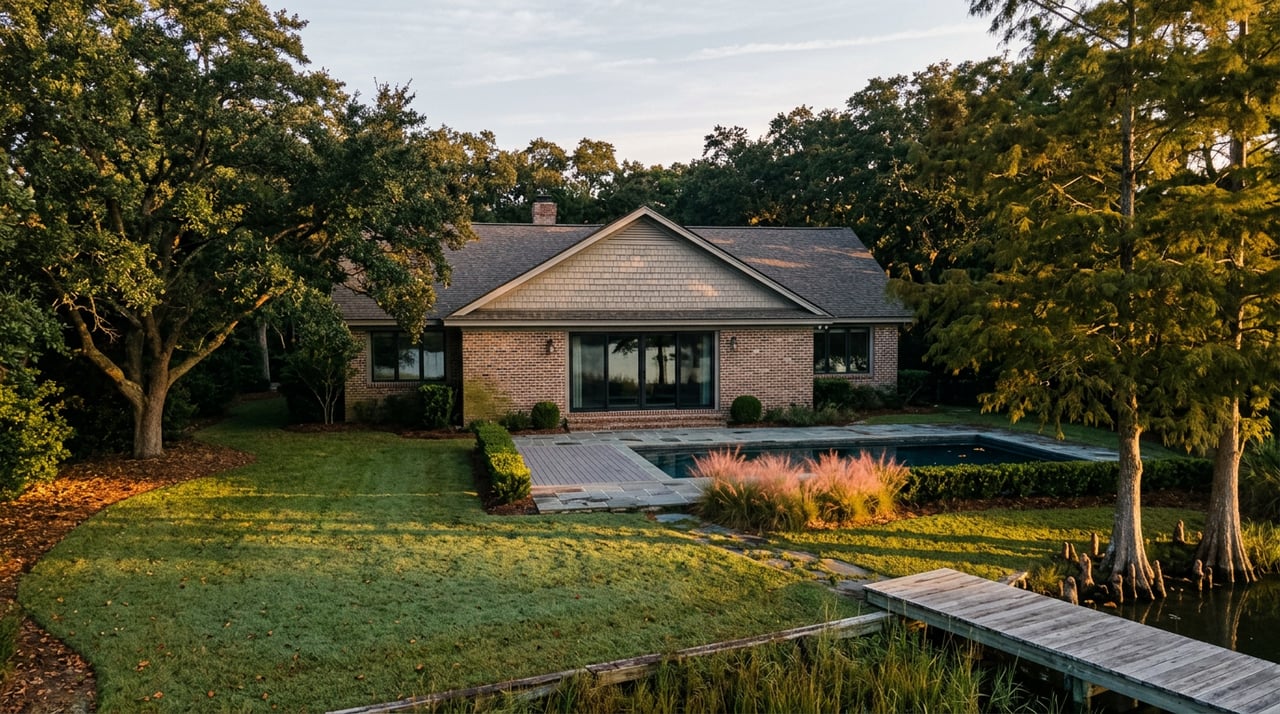
A recent Great Neck waterfront listing sat on 0.72 acres with a rip-rap bulkhead and four feet of water at low tide, priced against comparable dirt in the neighborhood. The house on it was labeled a tear-down in the listing sheet itself, with a cracked, settling slab foundation the seller described as not economically feasible to repair. That is the Great Neck market in one line. The peninsula sells lots, addresses, and school assignments. The structure is often incidental.
That is also why the headline median for Great Neck, reported by Redfin in May 2026 at $419,859 and down 8.2% year over year, tells a buyer almost nothing useful. The number is a weighted average of at least four different markets stacked on one peninsula, and the sub-neighborhood you pick determines whether you can dock a boat, which high school your kids attend, and whether any inventory exists at your price point at all.
One peninsula, four markets
Great Neck is bounded by Broad Bay to the east, the Eastern Branch of the Lynnhaven River to the west, and Linkhorn Bay at the southern point. Inside those water borders sit sub-neighborhoods with their own price ceilings, their own HOAs, and in some cases their own civic leagues. Treating them as one market is the mistake that produces bad offers.
| Sub-market | Recent median | What it actually is |
|---|---|---|
| Great Neck condos (Great Neck Landing, Great Neck Villas, Great Neck Grove) | $185K–$275K | Entry-level condo stock, mostly interior, no dock rights |
| Chesopeian Colony | $705K (Redfin, March 2026) | Established mid-century interior and canal-front, Cox HS |
| Broad Bay Island | $1,357,500 trailing 12 months (Homes.com) | Deep-water, single-exit island off Long Creek |
| Great Neck Point (Estates on the Lynnhaven, Wimbledon) | $1,797,500 (Movoto) | Luxury waterfront with dock access to the Lynnhaven Inlet |
The gap between the $705K interior median in Chesopeian Colony and the $1.8M waterfront median in Great Neck Point is not a "Great Neck premium." It is a different asset class purchased under the same ZIP code and the same middle-school assignment.
Why the peninsula does not add more houses
The reason the medians hold up in a softening region is supply, and the supply story on Great Neck is unusually blunt. The peninsula is fully developed, with no large lots left for new construction. Every sale is a resale of a lot that has already been assigned to a sub-neighborhood, a school, a flood zone, and a dock condition, decades ago.
That matters because REIN's April 2026 report showed the regional Hampton Roads median up 5.69% year over year with pending sales up 2.36%, while Great Neck's own May 2026 median printed down 8.2%. The peninsula did not lose value. The mix of what sold shifted toward interior product because there was almost nothing waterfront available to close. Great Neck's own days-on-market has been running near 28 to 32 days across 2026, faster than the citywide average, which is the pattern of a supply-constrained market where the good stock trades quickly and the median rides on whatever happened to close that month.
Deep water is a legal address, not a view
The single most expensive line on a Great Neck comp sheet is not square footage. It is deep-water access to the Chesapeake Bay under the Lesner Bridge through the Lynnhaven Inlet. Sub-neighborhoods that connect through the canal system to that inlet, including Great Neck Point, Broad Bay Island, Bay Island, and parts of Alanton, price on that connection. Sub-neighborhoods that show water from a window but do not have navigable, un-bridged depth to the bay do not.
A buyer reading a listing that describes "water views" or "canal frontage" should ask three questions before the offer, because the answers reset the price:
- Is there depth at mean low water sufficient to keep the boat you actually own, and is it documented?
- Is the bulkhead rip-rap, timber, or engineered, and how old is it?
- Are there fixed bridges between this dock and the Lynnhaven Inlet that cap air draft?
A canal-front lot with three feet at low tide and a fixed low bridge downstream is a very different asset than a Long Creek lot with a straight run under the Lesner Bridge to the bay. Both can list at "waterfront" prices. Only one of them supports the lifestyle most buyers are actually paying for.
The Cox/First Colonial line runs through the middle
Great Neck feeds into Virginia Beach City Public Schools, with elementary assignments splitting between John B. Dey and Thoroughgood, and high school splitting between Frank W. Cox and First Colonial depending on exact address. Both high schools are consistently ranked among the strongest in the district, so this is not a good-versus-bad question. It is a resale question. Buyers who relocate into Great Neck tend to write offers with a specific high school in mind, and when they sell in four to seven years, the next buyer will do the same. An address that sits on the wrong side of the school line for its price tier gets a smaller pool.
Cape Henry Collegiate, the private PK-12 school inside the Great Neck corridor, changes that math for a subset of buyers who are not shopping public-school lines at all. For everyone else, the public assignment is part of what the lot is worth, and it should be verified by street address at the school board level rather than by portal estimate.
Where the friction actually hits at closing
The transaction quirks on this peninsula cluster in predictable places. A buyer who has not closed in Great Neck before tends to underwrite the price and miss the carry costs and inspection surprises.
- Flood insurance on waterfront and canal lots. Properties near the water often fall in FEMA flood zones AE or VE. Coverage typically runs $1,500 to $3,000 a year depending on elevation certificate, first-floor height, and coverage limits, and it survives the closing regardless of what the seller was paying under a legacy policy.
- Bulkhead and dock condition. Timber bulkheads on the older canal cuts are frequently at or past their service life. A failed bulkhead is a five- to six-figure repair that a general home inspection will flag but not quantify. Marine contractor bids inside due diligence are the norm on any waterfront offer here.
- Slab and foundation age. Mid-century construction is common across Chesopeian Colony, Alanton, and parts of Broad Bay Island. Slab settling and cracking, as the tear-down listing above illustrated, is not rare, and it does not always show up on a walk-through.
- Single-exit evacuation on Broad Bay Island. The only exit from the island is on the western side, which means small hurricanes and tropical storms can trigger a full-island evacuation. Insurance carriers know this. Premiums reflect it.
- Tear-down math on waterfront lots. When the lot is worth more than the improvements, sellers often price for dirt and the "as-is" clause does real work. Buyers who plan to renovate rather than rebuild should price the demolition and the new-construction timeline into the offer, not the closing.
None of these are dealbreakers. They are line items. The buyers who get hurt on this peninsula are the ones who treat a Great Neck offer like a suburban tract offer and skip the marine contractor, the elevation certificate, and the dock survey.
The move
If you are shopping Great Neck against a Virginia Beach median, you are shopping the wrong number. Shop the sub-neighborhood median that matches the asset you actually want, then price the friction against it. A Chesopeian Colony interior colonial and a Great Neck Point waterfront are not competing for the same buyer, and the day the appraisal comes back, they will not comp against each other either.
FAQ
Is Great Neck the same market as Little Neck? No. Little Neck is the peninsula immediately west and shares much of the school and lifestyle profile, but Great Neck Road runs the full length of Great Neck from I-264 up to Shore Drive, giving it a through-route that Little Neck does not have. That single road changes commute patterns, retail placement along the corridor, and how sub-neighborhoods draw traffic.
Is there any new construction on the peninsula? Effectively no infill at scale. What trades as "new" is almost always a tear-down and rebuild on an existing lot, most often on the water where the land value justifies the demolition and the new build. Buyers looking for a community-pool, walking-trail, new-build product will find better inventory in the southern parts of Virginia Beach.
Which sub-neighborhoods carry HOAs, and does it matter? Broad Bay Point Greens and several of the smaller communities inside the corridor carry HOA structures. Broad Bay Island has an active civic league rather than a mandatory HOA. Ask for the current dues, the reserve study, and any special assessments in the last three years before you write the offer. On a peninsula this old, deferred community maintenance shows up in the assessment column, not the dues column.
How liquid is the waterfront market right now? Thinner than the interior market. The Great Neck Point median above sits on a small transaction count, so a single closing can move it materially. Broad Bay Island's 34-day average marketing time, per Homes.com's trailing-twelve-month data, tells you the buyer pool exists, but the specific asset a buyer wants may not appear inside a normal 90-day search window.
If you are underwriting a Great Neck purchase or preparing to list here, the sub-neighborhood comps, the dock survey, and the school-line verification are the three items that decide whether the price is right. Thompson and Partners works this peninsula lot by lot. Schedule a consultation and we will build the comp set that actually matches the address you are considering.